






Anadolu Medical Center was designed using evidence-based approaches and meets national and international accreditation and standardisation requirements.
International medical tourism authorisation
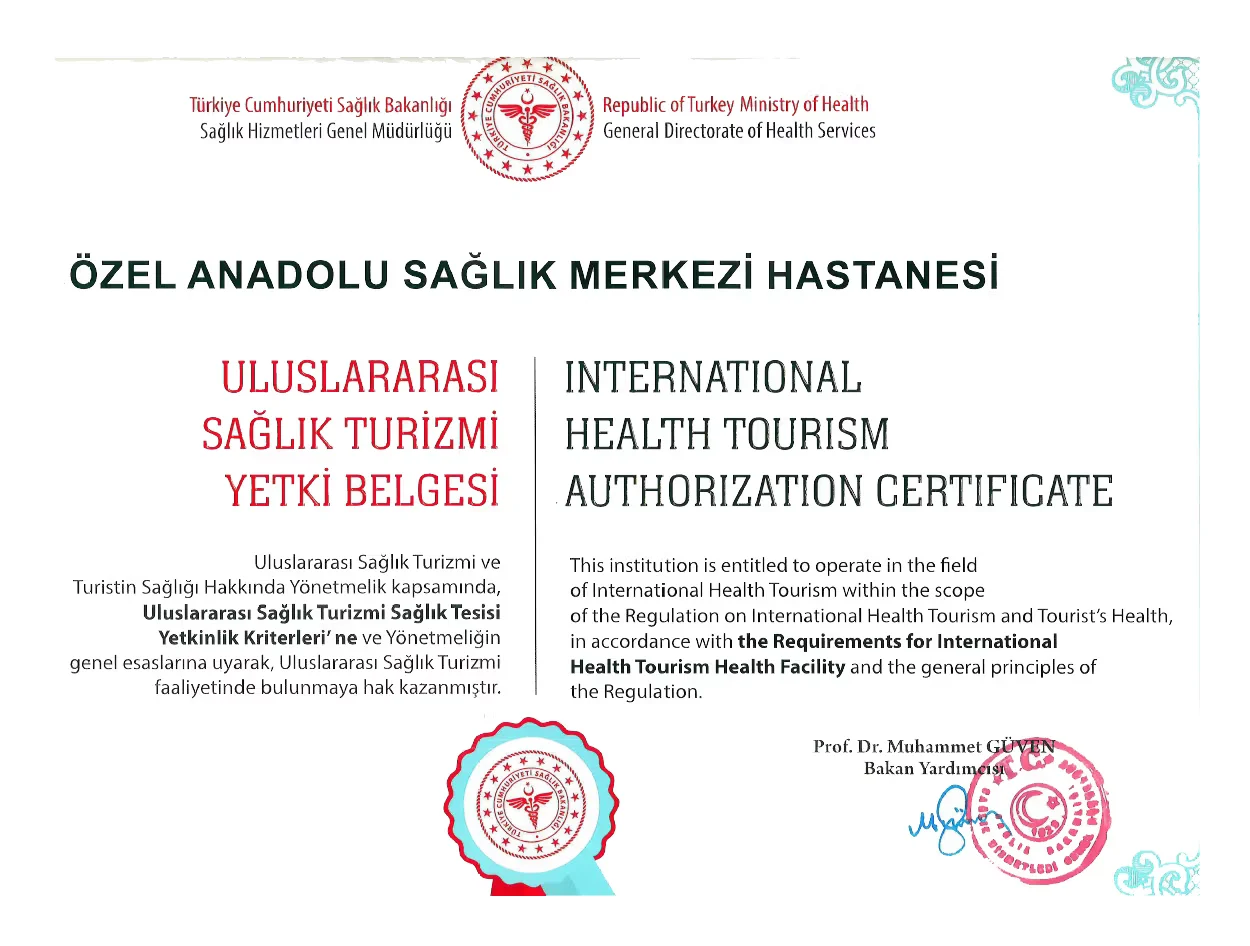
Anadolu Medical Center is officially authorised by the Turkish Ministry of Health for international medical tourism. This authorisation attests that the clinic meets the State's requirements for the care of international patients — both the quality of care and the support services: interpreting, transfers and follow-up of the patient throughout their journey.
1. Integrated Management System
Anadolu Medical Center obtained Integrated Management System certification before the end of its first year of operation.
Our hospital has obtained the following certifications:
- ISO 9001-2008: Quality Management System
- ISO 14001: Environmental Management System
- OHSAS 18001: Occupational Health and Safety
1.1) ISO 9001-2008 Quality Management System
ISO is the International Organization for Standardization. In Turkey, product-focused certification work was launched by the TSE (Turkish Standards Institution). The first certification for medical establishments was carried out in 1996.
- The ISO 9000 standards explain the fundamentals of the quality management system and define the terminology of quality methods.
- The ISO 9001 standards set out the requirements, in line with the established standards, for the quality management system that an organisation needs in order to increase customer satisfaction.
- The ISO 9004 standards provide a guide that takes into account the effectiveness and efficiency of the quality management system. The aim is to improve performance and satisfy customers.
- The ISO 19011 standards provide guidance for quality and environmental management systems.
The ISO 9000 standards can be summarised in 6 main themes:
- Requirements and rules
- Documentation requirements
- Management responsibility
- Resource management
- Product / service realisation
- Measurement, analysis and improvement
1.2) ISO 14001 Environmental Management System
ISO 14001 is a measure taken to preserve the natural structure and characteristics of the environment. The ISO 14001 standard for environmental management systems encourages the adoption of technologies that do not harm the environment and natural resources, and raises consumer awareness of this issue. It also helps to eliminate products and raw materials that are harmful to the environment.
The ISO 14001 environmental management system was put in place to identify and assess the environmental impact of our hospital's services and to control any additional impact. Anadolu Medical Center's principle of strict adherence to modern practices is an essential condition of the environmental management system.
Any organisation that meets the requirements of ISO 14001 environmental management system certification and obtains this certification must:
- Contribute to the prevention of pollution by managing and recycling waste.
- Reduce the consumption of natural resources by using its resources efficiently.
- Reduce costs by controlling waste.
- Build a strong sense of trust in society by protecting the environment and promoting environmental awareness.
- Ensure that its employees are proud to work for an organisation that is respectful of society and the environment
Our hospital complies with all legal requirements and implements improvements in the following areas, as part of its environmental management system:
Control of medical waste
- Control of hazardous waste
- Ensuring radiological safety
- Control of solid waste
- Control of water pollution
- Preservation of air quality
- Noise control
- Control of recycling, paper, toner and recyclable used oils
- Training of employees, patients, patients' relatives and subcontractors in environmental matters
- Efficient use of natural resources
- Ensuring that waste is collected in closed, leak-proof and odour-proof containers.
What does implementing the ISO 14001 environmental management system enable the hospital to do?
- The hospital provides its services in accordance with environmental laws and regulations.
- It manages and controls medical, solid, liquid and hazardous waste, manages gas emissions, controls noise and ensures radiological safety, in accordance with the regulations in force.
- It is prepared for disaster situations.
- It ensures the continuity of its success.
1.3) OHSAS 18001 Occupational Health and Safety Management System
The OHSAS 18001 Occupational Health and Safety (OHS) Management System describes the elements of operations that affect health and safety. It aims to ensure compliance with the laws in force, while enabling the continuous improvement and measurement of the development of the working environment and the achievement of objectives.
OHSAS 18001 (OHS) guarantees employees a safe and healthy working environment. OHS helps the organisation's employees carry out planned and systematic occupational health and safety actions in order to achieve better conditions of competitiveness.
2. JCI (Joint Commission International) Accreditation
Our hospital has been accredited by the JCI since 17 February 2007. This certification attests that the institution meets all the requirements of the series of standards defined by the JCI, with the aim of improving the quality of patient care, reducing risks by ensuring a safe environment for patients and staff, and guaranteeing continuous improvement.
The JCI standards are grouped into two main categories: patient-centred standards and organisation-centred standards.
Patient-centred standards
- Care and continuity of care
- Rights of patients and their relatives
- Patient assessment
- Patient care
- Anaesthesia and surgery
- Medication management and use
- Patient and family education
Management standards
- Quality improvement and patient safety
- Infection prevention and control
- Governance, leadership and direction
- Facility management and safety
- Staff qualifications and education
- Management of communication and information
ESMO (European Society for Medical Oncology)
The ESMO certification, awarded by the European Society for Medical Oncology, assesses the quality of care provided to patients with cancer and attests that all of the patient's needs are taken into account and that measures are implemented accordingly. Our hospital obtained this certification in October 2007 and was certified again in 2010.
We are a member of KalDer
The Turkish Association for Quality (KalDer) is a non-governmental organisation founded in 1991 by a group of volunteers. The aim of KalDer is to create favourable conditions for achieving an international level of quality and strengthening the competitiveness of all private and public businesses and organisations, as well as all non-governmental organisations. With more than 2,100 members, KalDer is a member of the European Foundation for Quality Management (EFQM). It launched the implementation of total quality management and the international quality movement in Turkey. Our hospital became a member of KalDer on 14 March 2008.
What does being a member of KalDer mean?
- Aiming for continuous improvement in competitiveness
- Being part of the international quality movement
- Offering and finding more opportunities for exchange and learning
- Being one of the organisations that adopt quality and excellence as a philosophy
- Being part of a large international family
- Being a winner! (winning with all of your stakeholders and in every respect)
What is the national quality movement?
It is a partnership with KalDer, undertaken by organisations in order to:
- Adopt total quality management;
- Implement the EFQM excellence model;
- Carry out a self-assessment based on this model.
Planetree Gold Accreditation
OUR PHILOSOPHY OF CARE
Before you come to our hospital, the only thing you need to do is tell us about your needs. We will personalise all of our services and adapt them to your expectations, so that you find your new surroundings just like home.
Our person-centred care service is the first of its kind in Turkey and the region. It places patients at the heart of every process and supports them from day one through an experience-based approach.
OECI (Organisation of European Cancer Institutes) Accreditation
By meeting the standards of the Organisation of European Cancer Institutes, Anadolu Medical Center has obtained OECI accreditation and is the first and only cancer centre in Turkey and the neighbouring geographical regions to do so.
The OECI is an independent citizens' organisation that has operated within the European Union since 1997. It registers all cancer centres and grants them accreditation after actively monitoring their progress.
The OECI accredits institutions that apply to be recognised as oncology centres after assessing them against its own standards, following the quality improvement process. It inspects the centres that apply and carries out in-depth work, taking into account the standards that are essential to the processes of cancer diagnosis, treatment and follow-up.
We are by your side at every moment
With our doctors, case managers, dietitians and, where necessary, psychologists, we are by your side 24 hours a day, 7 days a week at every stage of your treatment.
We put family unity first
After the diagnosis, we bring parents and doctors together so that your loved ones are informed about your condition and treatment as effectively as possible.
Care Partners Programme: this programme allows patients to involve their family and friends in their care.
Shared decision-making: we make all clinical decisions together with patients and their families in family meetings. During these meetings, the whole clinical team discusses the different treatment options with patients and their families.
Whiteboards: thanks to the boards placed in patients' rooms, our patients' daily schedule is no longer a mystery and they know, step by step, what will happen during the day.
Patient-managed visiting: you can choose to receive visitors 24 hours a day or to limit visits to certain hours.
Open medical records: you can view your medical records at any time and in any place. The doctor can sit at your bedside, present all of your clinical data to you, explain medical terms and answer all your questions.