














Sleeve gastrectomy package and price
Waiting time: none
Length of hospital stay: 3 nights (included in the package)
Minimum length of stay required abroad: 7 to 10 days
Price of sleeve gastrectomy: €3,400 laparoscopically, €5,150 robotically
The package includes:
- The medical fees for the initial and follow-up consultations
- The fees of the general surgeon and the assistant surgeon
- Before the procedure: consultations with the anaesthetist, endocrinologist, pulmonologist, cardiologist, nutritionist and psychologist, laboratory blood tests, ECG, echocardiography and chest X-ray.
- Before the procedure: gastroscopy and abdominal ultrasound
- Operating theatre costs
- Accommodation for up to 3 nights on the surgical floor, including a standard room, nursing care fees, a standard menu, and meal costs for the patient and 1 companion.
- The medical equipment and consumables needed for the procedure, as well as the medication related to the procedure
- An online consultation with the surgeon from your own country during the post-operative period
What is sleeve gastrectomy?
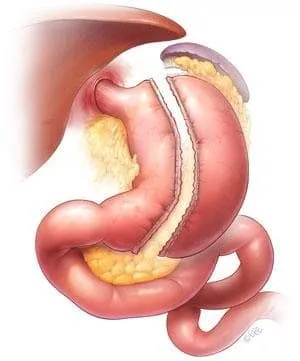
Sleeve gastrectomy involves removing a large part of the stomach, the part that provides its reservoir function. The stomach, which has a volume of 1.5 to 2 litres, is thus transformed into a thin tube with a capacity of 50 to 150 ml. With this technique, the amount of food that can be eaten at one time decreases, without disrupting the natural flow of the digestive system. The procedure is performed laparoscopically, that is, through 4 to 5 small incisions made near the navel. It lasts about 45 to 75 minutes. The length of hospital stay is generally 2 to 3 days.
The main advantages of sleeve gastrectomy are that it does not alter the natural flow of the digestive system — hence less frequent vitamin and mineral deficiencies —, that it causes less dumping syndrome, that it carries a lower risk of causing reflux and that no foreign body is introduced into the body. It does, however, have certain drawbacks: mainly reflux, the presence of a long staple line (bleeding and leakage along it) and the irreversible nature of the procedure. In other words, the undesirable effects of sleeve gastrectomy are fewer than those of gastric bypass and more extensive procedures.
How does sleeve gastrectomy work?
During the procedure, about 80% of the stomach is removed, leaving only a narrow gastric tube. The amount of food that can be eaten is thereby considerably reduced and the feeling of fullness comes on quickly: this is the restrictive effect of the procedure. In addition, the part of the stomach removed during sleeve gastrectomy is the part that produces ghrelin, the hormone responsible for the feeling of hunger. Its removal lowers the level of the hunger hormone in the blood and generally reduces appetite, which explains the metabolic and hormonal effects of the procedure. As the natural flow of the digestive system is not disrupted, digestion and absorption continue normally after a sleeve gastrectomy. The risk of vitamin and mineral deficiency is therefore lower.
What weight loss is achieved after a sleeve gastrectomy?
Obesity is a complex problem that cannot be reduced to an imbalance between calories taken in and calories burned. It rests on many hormonal mechanisms. When accompanied by a healthy diet and physical activity, sleeve gastrectomy allows 60 to 80% of excess weight to be lost in the one to two years following the procedure. On the other hand, if the recommendations are not followed and the old bad habits return, there is a risk of not losing the expected weight, or even of putting weight back on.
How long does recovery after the procedure take? When can I go home?
About 7 to 10 days. We recommend that our patients are followed up by a dietitian and a psychologist for at least 2 years after the procedure.
Robot-assisted sleeve gastrectomy
Surgical treatment is the most effective method, with proven effectiveness, in the management of patients with severe obesity and of patients with treatment-resistant type 2 diabetes. All obesity and metabolic surgery procedures can be performed using minimally invasive techniques (laparoscopic and robotic).
ROBOT-ASSISTED SURGERY, which is not available in every centre and which only a small number of surgeons have mastered, is in many respects superior to laparoscopic surgery. Robotic surgery is an operative technique that makes it possible to use instruments and equipment that minimise tissue damage during procedures. It has all the advantages of laparoscopic surgery: less pain, a shorter hospital stay and good cosmetic results. The cosmetic results of robotic surgery are excellent.
Robotic surgery can also be regarded as an advanced form of laparoscopic surgery. Its operating principles are similar to those of laparoscopy. First, 4 to 5 incisions of 8 mm are made in the abdominal wall, and the abdomen is then inflated with carbon dioxide to create a working space. Robotic arms specially designed for robotic surgery, which avoid damaging the abdominal wall, are then connected to these ports. The procedure is carried out using these highly mobile arms. A high-resolution camera is attached to one of the ports and transmits the surgical images both to the console from which the surgeon directs the operation and to the large screen placed at the head of the operating table. From this stage, the first surgeon hands over to an experienced assistant, sits at his or her own console and performs the procedure through the commands transmitted from it. The surgical console is the workstation where all the settings relating to the robot are made; the surgeon performs the operation using specific hand-held controls. The surgeon's movements are transmitted to the robot's arms, and the procedure is carried out thanks to the precision of the robotic arms' movements and their ease of access in confined spaces.
The three-dimensional, high-quality image from the robotic camera gives the surgeon the impression of operating with the naked eye. Thanks to the magnified image, even structures that the human eye can barely distinguish appear more clearly. The "wrist" part of the robotic arms works in the same way as the human wrist. With its high degree of mobility, it is even more flexible than the human wrist. This mobility makes it easy to carry out many difficult procedures with the robot, including in confined spaces. As these instruments are also powerful, they provide greater operative comfort, particularly in overweight (obese) patients. Thanks to all of the characteristics listed above, robotic surgery allows the surgeon to carry out the operative steps with great precision.
In conclusion, robotic surgery, which makes all the possibilities of modern technology available, can be used safely in the surgical treatment of morbid obesity and type 2 diabetes.
Robotic sleeve gastrectomy package and price
Waiting time: none
Length of hospital stay: 3 nights (included in the package)
Minimum length of stay required abroad: 7 to 10 days
Price of robotic sleeve gastrectomy: €5,150
The package includes:
- The medical fees for the initial and follow-up consultations
- The fees of the general surgeon and the assistant surgeon
- Before the procedure: consultations with the anaesthetist, endocrinologist, pulmonologist, cardiologist, nutritionist and psychologist, blood tests, ECG, echocardiography and chest X-ray.
- Before the procedure: gastroscopy and abdominal ultrasound
- Operating theatre costs
- Accommodation for up to 3 nights on the surgical floor, including a standard room, nursing care fees, a standard menu, and meal costs for the patient and 1 companion.
- The medical equipment and consumables needed for the procedure, as well as the medication related to the procedure
- An online consultation with the surgeon from your own country during the post-operative period
Abdulcabbar Kartal
Assoc. Prof. Dr.
Bariatric Surgery
Abdulcabbar Kartal
Assoc. Prof. Dr.
Bariatric Surgery
Experienced bariatric surgeon who has performed more than 500 laparoscopic and robot-assisted procedures. He holds a certification in minimally invasive surgery (laparoscopy / Da Vinci robotic surgery).
Areas of expertise and interests
- Bariatric surgery (sleeve gastrectomy, gastric bypass, SADI (single-anastomosis duodeno-ileal bypass))
- Robot-assisted bariatric surgery
- Advanced laparoscopic surgery
- Laparoscopic and open surgery for stomach cancer
- Laparoscopic hernia surgery (TAPP, TEP, ventral hernia)
- Laparoscopic and open colorectal surgery
Education and career
- Istanbul University Faculty of Medicine
- Şişli Etfal Training and Research Hospital
- Şanlıurfa Public Hospital
- Okan University Hospital
- Konak Private Hospital
- Anadolu Medical Center
Professional affiliations
- European Society of Coloproctology (Board-certified), member
- Turkish Society of Bariatric and Metabolic Surgery
- Turkish Society of Colon and Rectal Surgery (Board-certified), member
- Turkish Surgical Society (Board-certified), member
- Turkish Association of Laparoscopic and Endoscopic Surgery, member
- Turkish Association of Traumatology and Emergency Surgery, member